
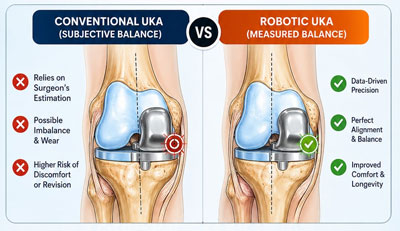
Knee pain due to osteoarthritis can significantly affect mobility and quality of life. For patients with isolated compartment arthritis, Unicompartmental Knee Arthroplasty (UKA)—also known as partial knee replacement—offers an effective, bone-preserving solution.
However, traditional UKA techniques rely heavily on surgical judgment, which can introduce variability. Today, Robotic UKA is transforming knee preservation surgery by bringing precision, consistency, and personalization to the forefront.
Robotic-assisted UKA is an advanced surgical technique that uses computer-guided planning and robotic assistance to perform partial knee replacement with high accuracy.
It allows surgeons to:
The result is a more controlled and predictable outcome compared to conventional methods.
👉 In simple terms:
Conventional = Estimation | Robotic = Precision
✔️ Superior Accuracy
Robotic assistance ensures precise alignment and positioning, which is critical for long-term success.
✔️ Better Knee Function
Accurate ligament balancing leads to a more natural-feeling knee movement.
✔️ Faster Recovery
Minimal soft tissue disruption allows:
✔️ Personalized Surgery
Each procedure is tailored to the patient’s anatomy, improving outcomes and satisfaction.
✔️ Improved Longevity
Better alignment and balance may reduce wear and increase implant lifespan.
Robotic UKA is best suited for patients with:
Proper evaluation by a specialist is essential to determine suitability.
With increasing awareness and access to advanced technology, patients are actively seeking minimally invasive and precision-based treatments.
Robotic UKA is becoming a preferred choice because it offers:
Yes, it is a safe and advanced technique that enhances surgical accuracy while remaining fully controlled by the surgeon.
Most patients begin walking within a day and recover faster compared to conventional knee replacement.
For selected patients, it preserves natural knee structures and offers better function than total knee replacement.
Postoperative pain is generally less due to minimal tissue damage.
Robotic UKA represents a significant advancement in knee preservation surgery. By combining surgical expertise with cutting-edge technology, it delivers precision, consistency, and improved patient outcomes.
As orthopedics continues to evolve, the shift is clear:
From conventional techniques → to robotic precision
Dr Prajyot Jagtap
Robotic Joint Replacement Surgeon | Joint Preservation Surgeon
📞 8655132456
📧 dr.prajyot@gmail.com